
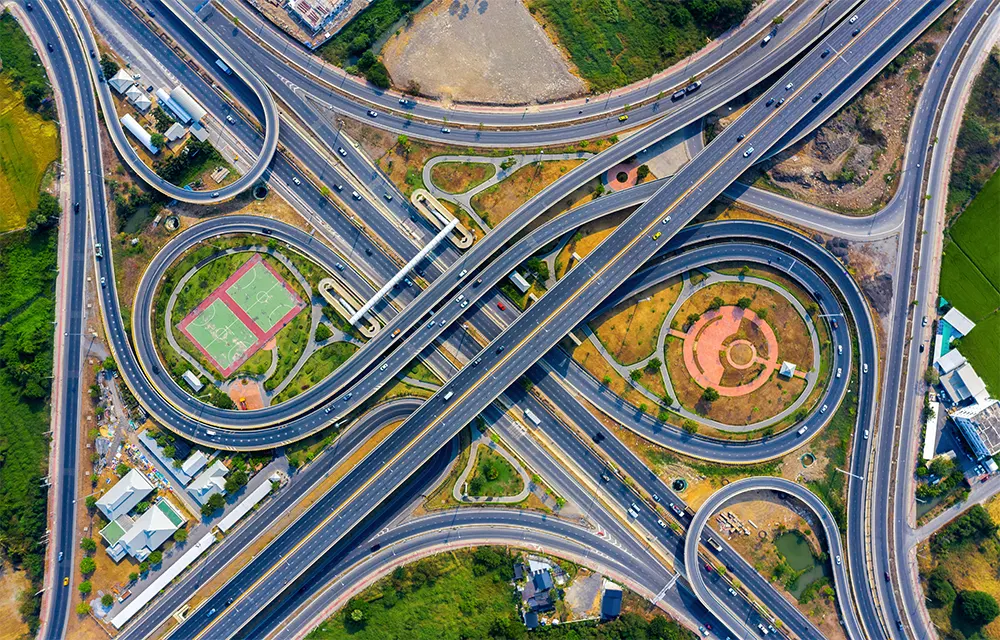
Highways and urban roadways are critical components of transportation infrastructure, serving as the lifelines that connect people, goods, and services. However, designing these networks is far from straightforward. Engineers must balance mobility, safety, environmental sustainability, and economic feasibility, all while addressing the urban roadway design challenges posed by growth and evolving transportation needs.
This article explores the urban roadway design challenges and how innovative solutions can help overcome them.
The Complexity of Modern Transportation Demands
Roadway design must keep pace with rapidly changing transportation patterns. Population growth, increased vehicle ownership, and urban expansion create pressure on road networks. Highways need to support long-distance freight transport, while urban roadways must facilitate local mobility, public transit, and pedestrian activity.
The urban roadway design challenges lies in designing roads that serve multiple user groups without compromising efficiency. For example, a highway must balance heavy truck traffic with passenger vehicles, while city roads must consider cyclists, pedestrians, and buses. This complexity makes roadway design a multi-disciplinary task.
Land Availability and Urban Constraints
In urban areas, limited land availability presents one of the biggest challenges in many urban roadway design challenges. Expanding or upgrading roadways often requires land acquisition, which can displace residents, businesses, or green spaces. This creates both social and environmental consequences.
Engineers must find creative solutions to maximize efficiency within tight spaces. Options include elevated roadways, underground tunnels, and smart traffic management systems. The urban roadway design challenges is achieving functionality without disrupting existing urban life or exceeding project budgets.
Safety Considerations in Roadway Design
Road safety is paramount, yet ensuring it in both highways and urban roads is challenging. On highways, high-speed traffic increases the risk of severe accidents, while in cities, mixed-use environments bring conflicts between vehicles, cyclists, and pedestrians.
Key safety challenges include:
- Intersection design in cities: Poorly designed intersections lead to congestion and accidents.
- Highway merging lanes: Inadequate merging space increases collision risks at high speeds.
- Pedestrian safety: Urban design must include crosswalks, signals, and protective barriers to safeguard vulnerable users.
Balancing mobility with safety requires thoughtful geometry, clear signage, and the use of smart technologies like adaptive traffic signals.
Environmental and Sustainability in Roadway Design Challenges
Highway and roadway projects often have significant environmental impacts. Land clearing, emissions from construction, and long-term traffic pollution all contribute to environmental degradation. Urban roads also increase impervious surfaces, exacerbating stormwater runoff and flooding risks.
Sustainability in roadway design now focuses on minimizing environmental harm by incorporating green infrastructure, such as permeable pavements, rain gardens, and noise-reduction barriers. Designing roads that encourage public transportation use and active mobility (walking and cycling) is also central to reducing environmental impacts.
Managing Congestion and Traffic Flow
Congestion is a persistent challenge in both urban and highway roadway design challenges. On highways, bottlenecks occur at interchanges and toll booths, while in cities, traffic lights, parking demands, and narrow streets contribute to delays.
Engineers employ strategies such as intelligent transportation systems (ITS), dedicated bus lanes, and dynamic tolling to manage congestion. However, balancing long-term solutions with immediate relief requires ongoing planning and significant investment.
Geotechnical and Structural Considerations
Every roadway project is shaped by site conditions. Engineers must account for soil stability, slope conditions, and groundwater presence when designing roads. In seismic regions, roads and bridges must be designed to withstand earthquakes.
For highways that traverse mountainous areas, slope stability and landslide risks demand retaining walls and drainage systems. Urban projects often face challenges with underground utilities, requiring precise engineering to prevent disruption to water, sewer, and energy networks.
Economic and Budgetary Limitations
Roadway design must balance ambition with budget. Infrastructure projects are often constrained by financial limitations, leading to compromises in scope or quality. Maintenance costs are also significant; roads must be designed not only for initial affordability but also for long-term durability and efficiency.
Engineers must adopt cost-effective methods without sacrificing safety or sustainability. This often means incorporating innovative materials, modular construction techniques, or phased project delivery.
The Role of Technology in Overcoming Challenges
Modern roadway design increasingly relies on technology to address these challenges. Simulation tools model traffic flow, while Building Information Modeling (BIM) enhances coordination across disciplines. Smart traffic systems manage congestion in real time, and data-driven planning ensures road designs meet actual demand.
Technology also supports sustainability by enabling precision in material use, monitoring environmental impacts, and ensuring resilience against climate-related risks.
Conclusion
Highway and urban roadway design is a multifaceted challenge that goes beyond laying asphalt and concrete. Engineers must address safety, environmental impacts, congestion, land constraints, and economic feasibility, all while meeting the evolving demands of modern society.
The complexity of these roadway design challenges highlights the importance of innovative, sustainable, and community-centered approaches. By blending advanced technology with sound engineering principles, roadway design can create safer, more efficient, and environmentally responsible transportation networks.
To learn how our engineering team supports sustainable roadway and infrastructure design, visit our Contact Us page and connect with us today.