
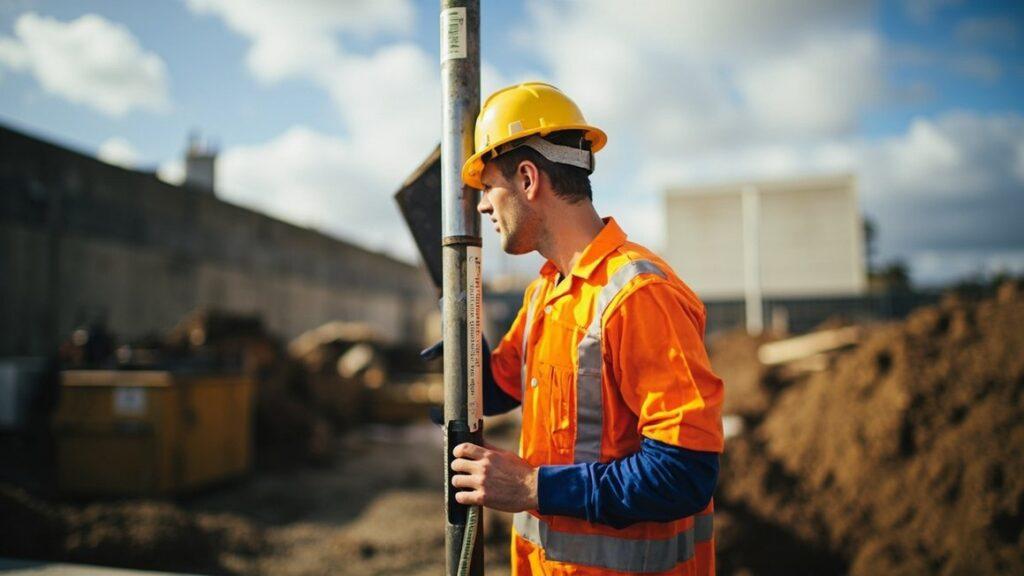
Choosing the wrong investigation method on a Christchurch liquefaction-prone site, or a Wellington hillside subject to slope instability, can cost a project weeks in re-drilling and thousands of dollars in redesign. Yet many clients still ask for “a few boreholes” without understanding that the method drives the quality, cost, and defensibility of every geotechnical recommendation that follows. In New Zealand, where the NZGS Field Description Guide and MBIE’s liquefaction assessment modules set clear expectations for investigation depth and rigour, selecting between CPT, SPT, and hand auger testing is not a formality — it is a decision that shapes the entire consenting and design pathway.
Why the Method Matters More Than Ever
Since the Canterbury earthquakes, New Zealand’s geotechnical practice has matured significantly. MBIE’s Guidance on the Investigation and Assessment of Liquefaction Hazards (Modules 1–5) explicitly recommends continuous-profile testing methods for sites where liquefaction is a credible hazard, effectively favouring the Cone Penetration Test (CPT) over traditional Standard Penetration Test (SPT) boreholes in many residential and commercial contexts. At the same time, the NZGS Field Description Guide (2005, updated guidance since) still requires accurate soil description and classification, which CPT alone cannot provide.
This creates a practical tension: engineers need continuous, repeatable data for liquefaction triggering analysis, but they also need physical soil samples for classification, plasticity testing, and groundwater characterisation. Understanding the strengths and limitations of each method — and when to combine them — is the difference between a site investigation that stands up to peer review and one that gets sent back by council.
Key takeaway: On a recent Tauranga subdivision consisting of interbedded pumiceous sands, a design relying solely on SPT data underestimated liquefaction susceptibility at 4–6 m depth because the 1.5 m test interval missed a thin loose sand lens. A supplementary CPT push identified the layer immediately, avoiding a costly post-construction remediation claim.
CPT: The Workhorse for Liquefaction Assessment
The CPT pushes an instrumented cone into the ground at a constant rate (typically 20 mm/s), recording tip resistance (qc), sleeve friction (fs), and often pore pressure (u2) continuously at 10–20 mm intervals. This continuous profile is exactly what MBIE’s liquefaction modules require for calculating factor of safety against triggering (FSliq) using methods such as Boulanger and Idriss (2014).
For a typical Christchurch residential site, a CPT to 15–20 m depth can be completed in half a day, compared to one to two days for an equivalent SPT borehole. Costs generally run 30–50% lower per metre than SPT boreholes, and the data resolution is an order of magnitude finer.
The trade-off is that CPT provides no physical sample. Soil behaviour type is inferred from qc, fs, and pore pressure ratios using classification charts (e.g., Robertson 2010), which is a strength-based proxy rather than a direct observation. In gravelly soils common in parts of Canterbury and Otago, cone refusal is common, limiting achievable depth.
This is the heart of the cpt-vs-spt-testing decision: CPT delivers density and stratigraphic detail ideal for liquefaction and settlement analysis, but it cannot replace direct soil description required under the NZGS guidelines.
Real-world example: On a Napier commercial redevelopment within a mapped liquefaction-prone area (per the regional council’s natural hazard overlay), CPT soundings at 10 m spacing across the site identified a discontinuous loose sand channel that SPT boreholes at wider spacing had missed in an earlier 2011 investigation, materially changing the foundation design from shallow pads to a stiffened raft.
SPT: Still the Standard for Direct Soil Sampling
The SPT, undertaken within a drilled borehole per AS 1289.6.3.1, drives a split-spoon sampler using a 63.5 kg hammer falling 760 mm, recording blow counts (N-values) over three 150 mm increments. Despite its lower resolution — typically one test per 0.75 to 1.5 m — the SPT remains indispensable because it recovers actual soil samples for logging against the NZGS Field Description Guide, Atterberg limit testing, and grain size analysis.
SPT is also the only practical method in gravelly, cobbly, or rocky ground where CPT refuses. In Queenstown Lakes or Hawke’s Bay sites with alluvial gravels, SPT boreholes with occasional core drilling are often the only viable investigation approach.
Energy correction matters here. New Zealand practice generally corrects field N-values to N60, and further to (N1)60cs for liquefaction analysis — a step MBIE guidance requires explicitly. Where hammer energy ratios are not measured or certified, blow count data becomes unreliable for quantitative analysis, a common quality gap identified in council peer reviews.
Key takeaway: A geotechnical engineer reviewing a subdivision consent in Selwyn District recently flagged that SPT hammer energy had not been calibrated in over three years, meaning all liquefaction triggering calculations submitted required conservative default correction factors — adding uncertainty the developer could have avoided with a $500 hammer energy calibration.
As one senior NZGS-registered engineering geologist notes, “SPT gives you a sample in your hand and a number on a page, but that number is only as good as the equipment calibration behind it. CPT gives you the profile; SPT gives you the ground truth. Good practice uses both, not one instead of the other.”
Hand Auger: Fast, Cheap, and Strictly Limited
Hand augering remains a legitimate first-pass tool for shallow investigations — typically to 3–5 m in soft, non-gravelly soils — particularly for residential foundation assessments under NZS 3604 scope, preliminary soil classification, or supplementing desktop studies before committing to mechanical rigs. It is low-cost, requires no heavy machinery access, and can be mobilised the same day.
However, hand auger investigations have no place in liquefaction assessment beyond initial screening. MBIE guidance is unambiguous that quantitative liquefaction triggering analysis requires either CPT or SPT data to appropriate depth (commonly 15–20 m, or to a depth where soils are clearly non-liquefiable). Hand auger cannot penetrate dense layers, cannot provide the strength parameters needed for bearing capacity design beyond simple shallow footings, and offers no continuous profile.
Practical example: For a simple single-storey dwelling on flat, well-drained land outside any mapped natural hazard overlay in a district plan, hand auger to 1.5 m confirming NZS 3604 “good ground” may be entirely sufficient — provided no liquefaction, expansive soil, or slope instability triggers apply. But the same method on a site within a Regional Council flood or liquefaction hazard overlay will almost certainly be rejected by council duty engineers as inadequate.
Matching Method to Site Context
The right approach depends on hazard context, ground conditions, and consent requirements:
- Liquefaction-prone flat land (e.g., parts of Christchurch, Napier, Wellington’s reclaimed areas): CPT as primary tool, supplemented by SPT boreholes at 10–20% of CPT locations for soil sampling and classification.
- Gravelly alluvial or hillside sites (Queenstown, Nelson, Hawke’s Bay foothills): SPT boreholes with core drilling; CPT often unviable due to refusal.
- Simple residential sites with no mapped hazards: Hand auger and scala penetrometer testing may suffice under NZS 3604, subject to a desktop hazard screening.
- Deep foundation or major structure design: Combined CPT and SPT programme, calibrated to AS/NZS 1726 and site-specific ground models, almost always required by structural engineers and territorial authority peer reviewers.
Getting the Investigation Right the First Time
Under-investigating a site rarely saves money — it simply defers cost and risk to construction or, worse, post-construction remediation. Territorial authorities across New Zealand are increasingly scrutinising geotechnical reports against MBIE and NZGS expectations, and a mismatched investigation method is one of the most common reasons for requests for further information (RFIs) during consent processing.
Chambers Consultants works with clients from early feasibility through to construction monitoring, designing site-specific investigation programmes that balance cost, consenting timeframes, and technical defensibility. If you are planning a subdivision, commercial development, or residential build anywhere in New Zealand, talk to our geotechnical team before you commit to a drilling programme — the right method chosen upfront will save you time, money, and consent delays down the line. Contact Chambers Consultants today to scope an investigation tailored to your site.