
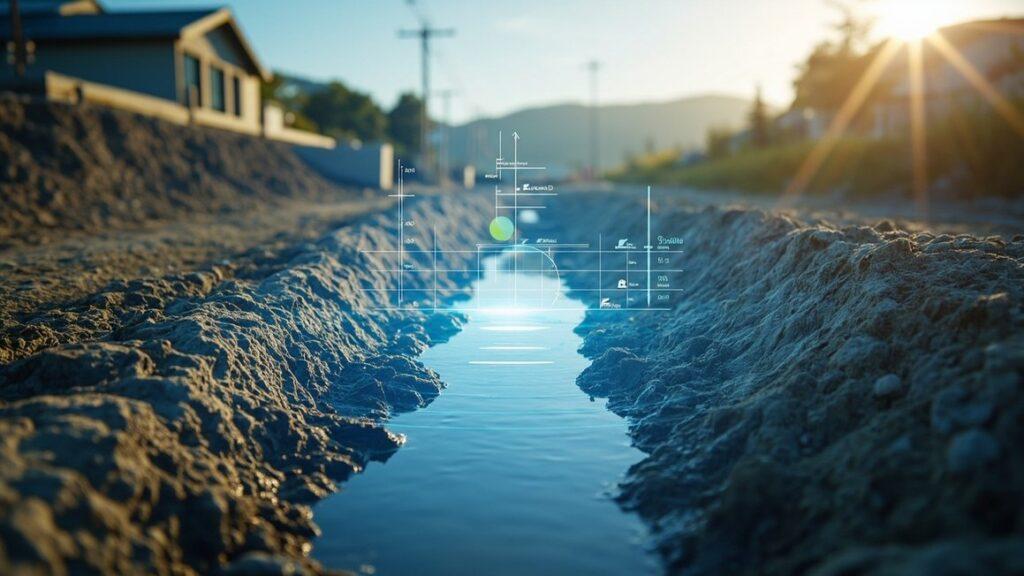
A geotechnical investigation that misses a perched water table doesn’t just cause a wet basement — it can trigger foundation heave, retaining wall failure, and six-figure remediation bills years after practical completion. In New Zealand’s residual clay and volcanic soil terrains, from Auckland’s Waitematā clays to the ignimbrite and tephra sequences of the central North Island, perched groundwater is one of the most under-diagnosed risks in site development. Getting groundwater-geotechnical-design right from the outset is not a luxury; it is the difference between a durable structure and a costly, litigious defect claim.
Why Perched Water Tables Form in NZ Soils
Perched water tables occur where a discontinuous, low-permeability layer intercepts infiltrating rainfall or irrigation water above the true regional water table, creating a temporary saturated zone. New Zealand’s residual soil profiles are almost purpose-built to generate this condition. Weathered volcanic ash (tephra), allophanic clays, and residual clays derived from greywacke or mudstone typically weather unevenly, producing a heterogeneous profile of permeable, structured topsoil overlying denser, less permeable clay horizons or weathered rock.
In Auckland, this is a well-documented issue in the residual clays overlying East Coast Bays Formation and Waitematā Group sandstones and mudstones. Rainfall infiltrates the more permeable colluvium or fill material, then mounds on top of the less permeable in-situ clay, sometimes only 1.5 to 3 metres below ground level. In the Waikato and Bay of Plenty, pumiceous and tephra-derived soils behave similarly, with buried paleosols or ash bands acting as aquitards. These perched zones are highly seasonal and can rise by more than a metre within days of sustained rainfall, then disappear entirely over a dry summer — which is precisely why a single piezometer reading taken during a site investigation can be dangerously misleading.
The consequence for practitioners is clear: standard water table assumptions based on a single wet-season or dry-season reading are inadequate. Design must account for the full seasonal envelope of groundwater behaviour, not a snapshot.
Design Implications: Seepage, Drainage and Tanking
Perched groundwater directly affects three core geotechnical design elements: slope stability and seepage pressures, subsoil drainage system capacity, and basement waterproofing (tanking) strategy.
Seepage forces from perched water reduce effective stress in slopes and behind retaining structures, lowering the factor of safety against slip failure. This is a leading contributor to shallow translational slips in Wellington’s residual clay hillsides and Auckland’s volcanic cone margins, particularly where cut slopes intercept a perched horizon and create a seepage face. Design engineers must incorporate pore pressure regimes reflecting the perched condition into limit equilibrium or finite element stability models, not merely the regional water table used in desktop assessments.
Subsoil drainage design under NZS 4404:2010 and good practice guidance requires drainage systems sized for peak, not average, seepage flows. Undersized filter drains or blocked outlets are a recurring cause of post-construction dampness and slope instability. For basements, AS/NZS 3500 and NZBC Clause E2 (External Moisture) performance requirements demand that tanking systems be designed for hydrostatic and seepage pressures that may be intermittent but locally severe. A basement designed only for a “normal” static water table, without allowance for perched seepage during storm events, is a defect waiting to surface.
The practical reality is that perched water is often more damaging in the short term than a permanent high water table, precisely because it is transient, unpredictable, and frequently under-monitored.
Key Takeaways from Real NZ Sites
- Seasonal monitoring is non-negotiable: A hillside residential development in the Waitākere foothills experienced retaining wall distress within 18 months of completion after a single dry-season groundwater reading failed to identify a perched table that rose to within 0.8 metres of the surface during winter. Retrofitting a raked drainage blanket cost more than three times the original design allowance.
- Layered stratigraphy demands layered instrumentation: On a Hamilton subdivision underlain by pumiceous tephra over a buried paleosol, standpipe piezometers installed at a single depth missed a shallow perched zone entirely. Multi-level piezometer nests, installed at 1.5 m intervals, are now standard practice for volcanic soil sites of this type.
- Basement tanking must assume intermittent hydrostatic loading: A commercial basement in central Wellington, designed to a “dry site” assumption based on desktop data, suffered active seepage through construction joints during its first major rainfall event. Post-construction remediation with injected resin waterstops and an external tanking membrane addressed the issue, but at significant cost compared to designing for the condition upfront.
- Subsoil drains need redundancy and access for maintenance: Several Tauranga sites have shown that filter drains installed without inspection points or adequate fall become silted and ineffective within five to seven years, allowing perched water to re-establish and saturate pavement subgrades.
What Robust Groundwater-Geotechnical Design Looks Like
Effective management starts at the investigation stage, not the drawing board. Site investigations in residual clay and volcanic soil terrain should include multi-season groundwater monitoring wherever practicable, or at minimum, a documented assessment of seasonal variability using regional hydrogeological data, historical rainfall records, and site geomorphology. Where perched conditions are suspected, nested piezometers at varying depths — rather than a single standpipe — should be specified to characterise the vertical distribution of pore pressure.
As one senior geotechnical practitioner engaged on Auckland Unitary Plan hillside developments has noted, “The biggest single mistake we see on residual soil sites isn’t poor design — it’s under-characterised groundwater. Engineers design brilliant drainage systems for the wrong water table.” This observation reflects a broader industry pattern: technical competence in drainage and retaining design is rarely the limiting factor; the quality and seasonality of the groundwater data feeding that design usually is.
Design responses should include conservative, redundant subsoil drainage — combining cut-off drains upslope of structures with collector drains and positive outlets discharging to stormwater systems in accordance with regional and district plan requirements (such as those administered under the Auckland Unitary Plan and equivalent regional plans elsewhere). Basement tanking design should follow a belt-and-braces approach: a combination of external membrane systems, internal cavity drainage, and sump/pump systems designed to NZBC E1 and E2 performance requirements, rather than relying on a single waterproofing line of defence. Retaining structures should incorporate drainage composites or granular drainage zones behind the wall, with pore pressure relief explicitly modelled in stability analyses to AS/NZS 1170 loading combinations.
Ongoing performance monitoring, including inspection chambers on subsoil drains and periodic piezometer readings during the defects liability period, allows early identification of drainage underperformance before it manifests as structural distress.
Building Resilience into Every Site
Perched water tables are not an exotic risk confined to unusual sites — they are a routine feature of New Zealand’s residual clay and volcanic soil geology, and they demand routine, disciplined engineering response. The developments that avoid costly remediation are consistently those where geotechnical engineers invested in seasonal groundwater characterisation, designed drainage and tanking systems with genuine redundancy, and built in monitoring provisions rather than treating groundwater as a fixed design input.
For developers, designers, and asset owners operating on residual soil or volcanic terrain anywhere in New Zealand, the message is straightforward: treat groundwater as a dynamic, seasonal variable central to your geotechnical design, not a footnote in the site investigation report.
If your project sits on residual clay, volcanic ash, or pumiceous soils, and your groundwater assessment is based on a single site visit, it’s time for a second look. Contact Chambers Consultants to discuss a tailored groundwater-geotechnical design review for your site, before a perched water table becomes an expensive surprise.