
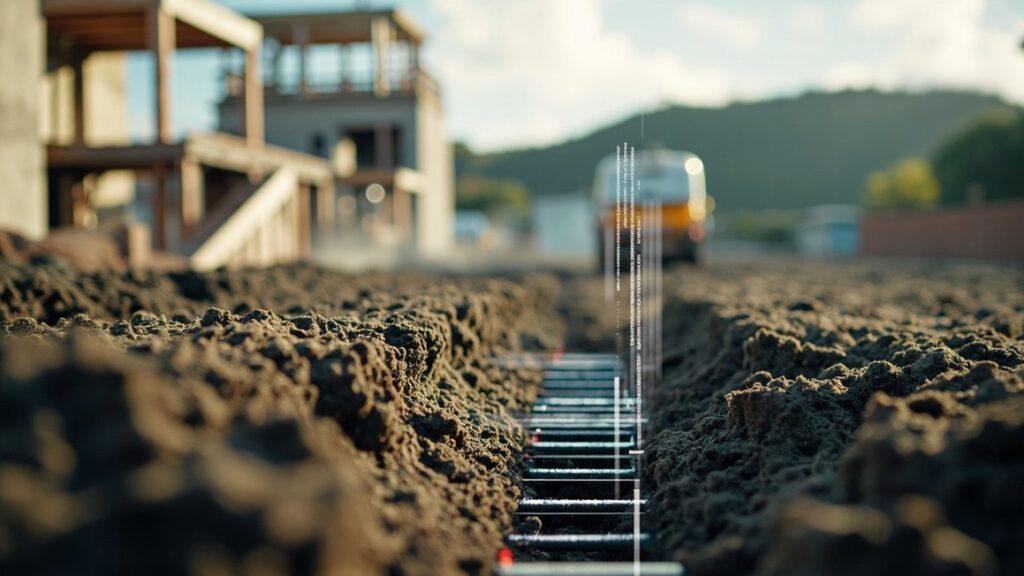
Every year, thousands of New Zealand homeowners discover the hard way that a foundation is not a commodity decision. Cracked linings, sticking doors, and slab heave following a wet winter on Waikato peat or Christchurch silt are not bad luck—they are the predictable result of matching the wrong slab system to the wrong ground. Choosing between a waffle raft and a conventional slab-on-ground is one of the highest-leverage decisions in residential construction, and it deserves more scrutiny than it typically receives.
At Chambers Consultants, we assess dozens of sites each year where the geotechnical report, the structural design, and the builder’s default slab choice are not aligned. This article sets out the engineering logic behind waffle raft and conventional slab selection, with specific reference to New Zealand’s building code framework and the ground conditions that make this country’s residential foundation design genuinely challenging.
Understanding the Two Systems
A conventional slab-on-ground is a reinforced concrete slab, typically 100mm thick, poured over a prepared and compacted hardfill layer, usually with thickened edge beams and internal ribs designed per NZS 3604 or specific engineering design. It relies on the supporting ground remaining stable and relatively uniform in its bearing behaviour. Where ground conditions are good—shallow, well-compacted, non-reactive soils with acceptable bearing capacity—a conventional slab is often the most cost-effective and straightforforward solution.
A waffle-raft-slab-nz system, by contrast, is a ribbed raft slab formed over a grid of expanded polystyrene (EPS) pods, creating a network of reinforced concrete ribs in both directions beneath a structural slab. The RibRaft system, developed and licensed by Firth, is the dominant proprietary version used across New Zealand, though other waffle pod systems exist. The ribbed structure behaves as a stiffened raft, distributing loads across the whole footprint and allowing the slab to flex and move as a coherent unit rather than relying on a single uniform bearing surface.
This structural distinction is the entire basis for the design decision. A conventional slab performs well when the ground underneath is dependable. A waffle raft is engineered specifically for situations where the ground is not entirely dependable—where some differential movement is expected and the foundation needs to accommodate it without transferring that movement into the structure above.
Why NZ Ground Conditions Demand This Choice
New Zealand’s residential geotechnical landscape is unusually varied for a country of five million people. Expansive clays across parts of Auckland, Hamilton, and Christchurch’s Port Hills swell and shrink seasonally, generating differential ground movement that can exceed 40mm across a building platform in a dry summer followed by a wet winter. Liquefiable soils, dramatically highlighted by the Canterbury earthquake sequence of 2010–2011, remain a live design consideration across much of Christchurch, parts of the Hutt Valley, and other alluvial and reclaimed land throughout the country.
MBIE’s guidance following the Canterbury rebuild formalised a Technical Category (TC) system—TC1, TC2, and TC3—that grades residential sites according to liquefaction risk and expected ground performance in a moderate earthquake. TC2 and TC3 sites frequently require enhanced foundation systems, and RibRaft-type waffle slabs, often combined with ground improvement such as stone columns or engineered fill, have become the standard specification in these zones because the ribbed raft structure tolerates differential settlement far better than a conventional slab.
NZS 3604:2011 (Timber-Framed Buildings) provides the baseline for conventional low-risk residential construction, but it explicitly excludes sites with expansive soils, uncontrolled fill, or significant liquefaction potential from its scope. Any site falling outside NZS 3604 parameters requires specific engineering design under the NZ Building Code, typically referencing AS 2870 (Residential Slabs and Footings) for expansive soil classification, even though AS 2870 is an Australian standard adapted for New Zealand practice in the absence of a direct equivalent.
The Engineering Case for Waffle Rafts on Difficult Ground
The ribbed raft geometry of a waffle slab gives it two critical advantages over a conventional slab on reactive or variable ground. First, the interconnected rib network acts compositely, meaning the slab redistributes load away from any localised soft spot or zone of differential heave, rather than concentrating stress at a single point of weakness. Second, the EPS pods reduce the concrete’s direct contact with the ground, which lessens the moisture transfer that drives clay expansion and contraction directly beneath the slab.
Geotechnical engineer Dr. Sherwyn Peters, commenting on residential foundation performance in reactive soils, has noted that “the majority of slab distress claims we investigate stem from a mismatch between the actual site classification and the foundation system installed—not from inherent flaws in either system.” This observation aligns with what Chambers Consultants sees in practice: waffle rafts are not inherently superior, they are situationally superior, and the failure mode is almost always a classification or specification error upstream of construction.
On genuinely expansive sites classified as “H” (highly reactive) or “E” (extremely reactive) under AS 2870 methodology, a stiffened waffle raft with deepened perimeter beams can accommodate a design surface movement (ys) of up to 40–75mm without transferring damaging differential movement into the superstructure. A conventional slab attempting the same performance would require substantially thicker sections and heavier reinforcement to achieve comparable stiffness, often eroding any cost advantage it initially held.
When a Conventional Slab Remains the Right Call
It would be a mistake to treat waffle rafts as a universal default. On good ground—classified as Class A or S under AS 2870, with low reactivity, adequate bearing capacity confirmed by a geotechnical investigation, and no liquefaction risk identified in the TC assessment—a conventional slab remains the more economical and entirely appropriate choice. Over-specifying a waffle raft on straightforward ground adds unnecessary cost, typically 10–15% above a comparable conventional slab, without a corresponding performance benefit.
The decision should never be made by default or by builder preference alone. It should follow directly from a site-specific geotechnical investigation, appropriate soil classification, and a foundation design that responds to what the ground investigation actually reveals.
Key Takeaways for Homeowners and Developers
- Site investigation comes first, foundation choice comes second. A geotechnical report and soil classification under AS 2870 should always precede foundation selection—not follow it. On a recent Pukekohe subdivision, three adjoining lots returned three different reactivity classifications, requiring three different slab specifications despite identical house plans.
- Waffle rafts earn their premium on reactive clay and TC2/TC3 ground. The 10–15% cost premium over a conventional slab is typically justified where expected differential ground movement exceeds what NZS 3604 or a standard slab can tolerate.
- Liquefaction risk changes the calculation entirely. On Christchurch TC3 sites, RibRaft systems combined with ground improvement have become the practical standard, reflecting lessons learned directly from the 2010–2011 earthquake sequence.
- Don’t over-engineer good ground. On stable, low-reactivity sites, a conventional slab remains cost-effective and code-compliant; specifying a waffle raft here adds cost without adding value.
- Detailing at the edges matters as much as the slab type. Poor site drainage, inadequate edge beam depth, or tree proximity within 1.5 times mature height can undermine even a correctly specified waffle raft on reactive clay.
Getting the Specification Right
The waffle raft versus conventional slab decision is ultimately a question of matching structural behaviour to ground behaviour, informed by proper site investigation rather than habit or convenience. New Zealand’s geological diversity means there is no single correct answer nationwide—only a correct answer for each site, once the ground has been properly understood.
If you are planning a residential development or custom build and want certainty that your foundation specification matches your actual ground conditions, Chambers Consultants can arrange a full geotechnical assessment and provide an independent engineering recommendation before you commit to a slab system. Contact our foundations team today to discuss your site and ensure your foundation is designed for the ground it will actually sit on, not the ground you assumed it would.